In a flurry of footsteps, an eager group of Year 6 students dash across campus to solve hidden maths problems.
'It's over here!' a student beckons. The students huddle together to solve the problem and unravel the next clue:
'I'm not an elevator, but I rise,
with every step, you gain the prize.
So don't just stand there—take the dare,
find your next question halfway in the air!'
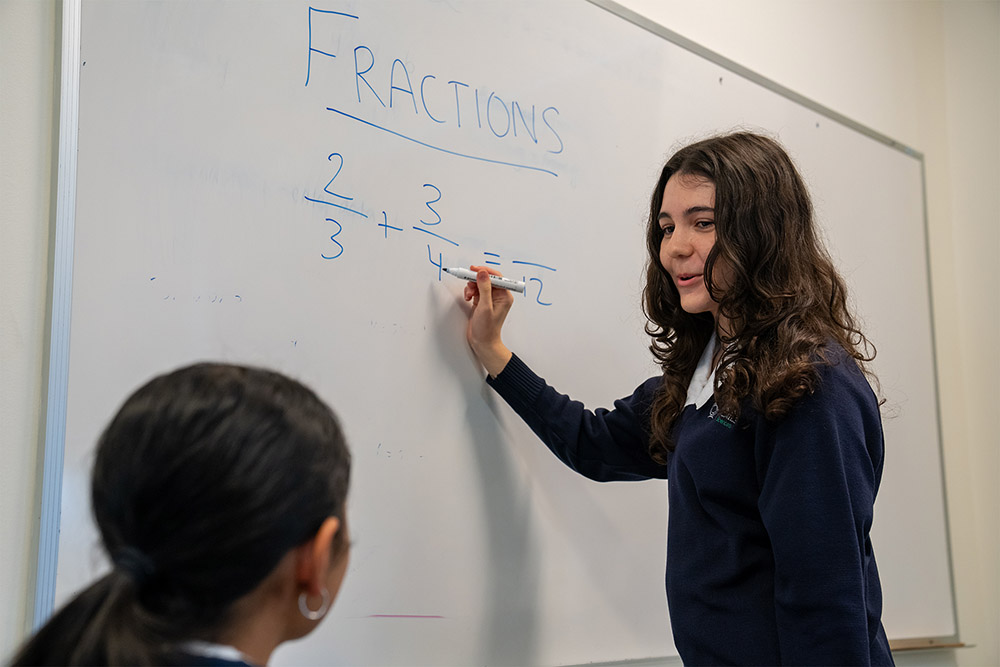
In this after-school maths class, there are no textbooks and students are selected from a mix of Gold Coast primary schools. While a teacher supervises, 6 senior secondary students at Queensland Academies Health Sciences Campus (QAHS) plan and deliver the lesson.
Kiara is one of 50 Year 11 students to step into teachers' shoes through an annual, peer mentorship program.
Kiara says her group taught the Year 6 students somewhat challenging maths concepts before taking the class outdoors.
'My favourite thing was that we got to be creative, so we chose to do a scavenger hunt,' she says.
'It was a really enjoyable experience. In the future I'd like to explore teaching, mentoring or another way to share my knowledge with other people.'
The STEM Mentor Masterclass program is unique to QAHS, a state school for highly capable Year 10–12 students on the Gold Coast.
In Semester 1 each year, the Year 11 student mentors plan and deliver 2, 90-minute lessons to extend and inspire science, technology, engineering and mathematics (STEM) learning in younger students.
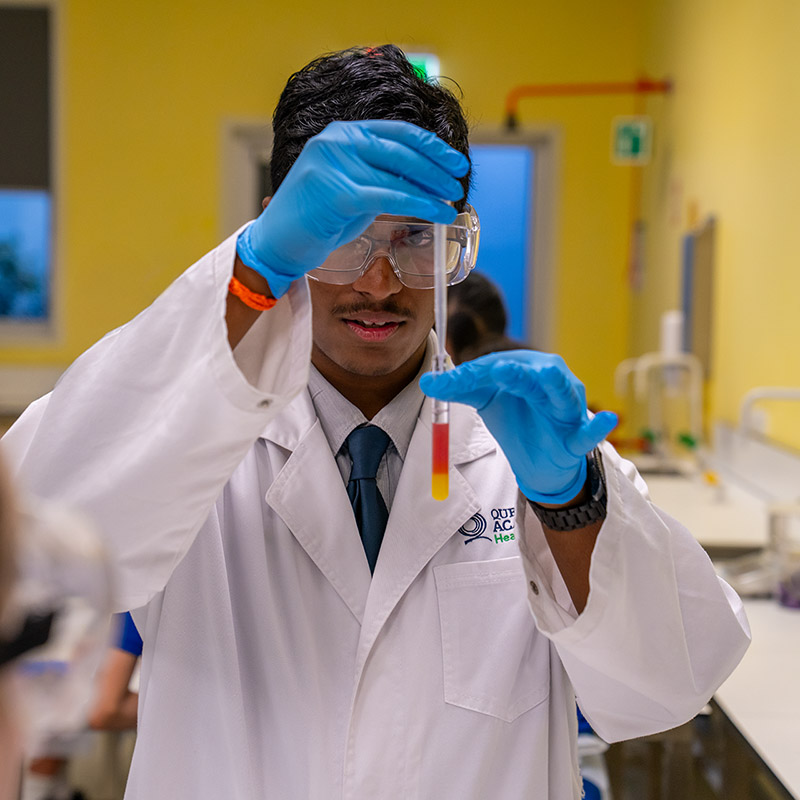
But it's not just maths challenges engaging students. In the science lab, Year 11 student Pranav Nithish demonstrates how chemicals mix and react with each other while his group of Year 6 students watch in awe.
Pranav Nithish first joined the STEM Mentor Masterclass program in Year 6 and was excited to return as a Year 11 mentor this year.
When Pranav Nithish reflects on his first experience in the program, he says it was interesting to be taught by another student like him.
'I remember they had good experiments and I found it really fun and engaging. The mentors were also very supportive,' he says.
'I'm happy I got to do the same thing those mentors did for me and give back to another group of Year 6s.
'I really enjoyed seeing the astonishment on their faces as they watched the colour change when a solution shifted from an acid to a base.'
Principal Vanessa Rebgetz says the idea for the student mentorship program came from a single student who was involved in the STEM Girl Power Initiative in Year 9.
'This student started Year 10 at our school in 2017 and workshopped her idea with us about how to carry on mentoring other young students in STEM,' she says.
'She designed the activities and delivered the pilot with 4 other students. And, when she was in Year 11, she trained a group of Year 10s to become the next STEM mentors.
'Since then, the program has grown to be a highly sought-after position.'
Teacher Patrick Emery coordinates the STEM Mentor Masterclass program and says students take a lot of pride in being ‘teachers' and mentors to younger students.
'Another thing that makes the program so popular is its hands-off approach,' he says.
'Teachers still need to assist logistically for some things, but the students have the autonomy to design the lesson themselves and take ownership of it.'
Student mentors teach masterclasses in either physics, chemistry, maths, or sports, exercise and health science—with their love of learning shining through.
'Those students bring an energy and a passion to ignite interest in Year 6s in a different way to what teachers would do—it's a unique relationship that they share,' Vanessa says.
Patrick says students proudly list the STEM mentor program on their university applications and resumes.
'I've had feedback from our graduates who say the program was a big part of their development, particularly when they get to university,' Patrick says.
'They learn how to be a group member and how to navigate that, while individually they take on leadership and responsibility.
'Overall, it gives them a lot of confidence in presenting, communicating and collaborating with other people.'
Mentorship culture supporting national student achievements
QAHS embeds a culture of mentorship by connecting students with alumni and industry professionals, leading to incredible student success.
'All of our students study the International Baccalaureate Diploma Programme in Years 11 and 12, which requires them to complete a 4,000-word extended research essay,' Vanessa says.
'Those who choose to do theirs in science can use their research to enter the CSIRO's CREST [Creativity in Research, Engineering, Science and Technology] program.
'The students work with Griffith University and industry mentors on this project and the level of students' research is outstanding.
'Each year we have 10 or more students achieving CREST Gold Awards. It's a real champion piece in our school to achieve this award and have your research recognised.
'Mentorship is a part of our culture and it's vibrant, alive and integral to continuing to build on our students' success.'